

'Good Omens' Ended as It Began: As a Love Story
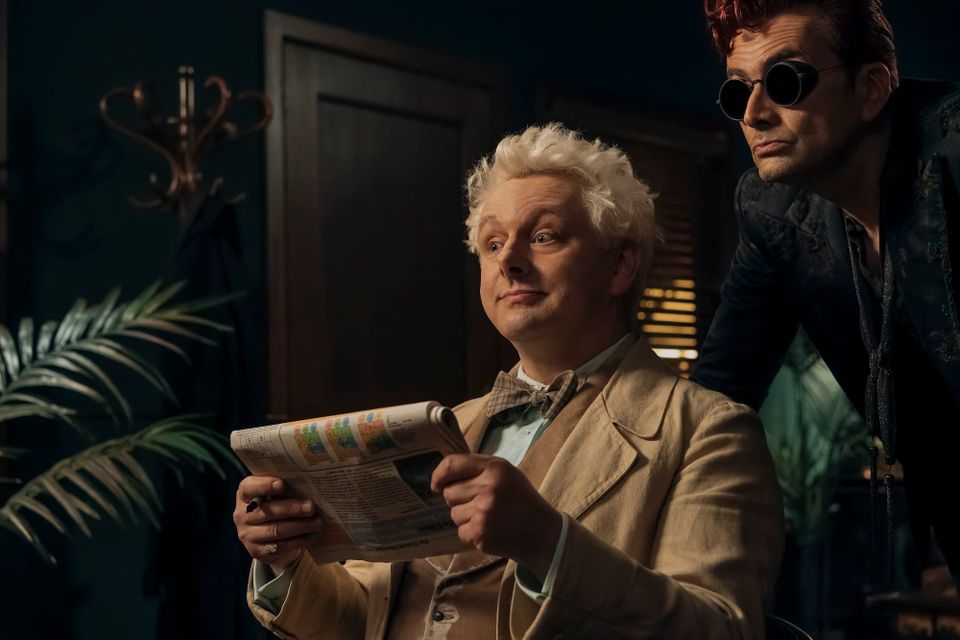
Good Omens is a series that wrestles with many big concepts: Faith, free will, destiny, morality, and forgiveness. But, in the simplest sense, Good Omens is a love story. It embraces love of every size and variety, but is most often told through the unconventional relationship between a caustic demon named Crowley and a bookish angel called Aziraphale. After three seasons — well, two seasons and a badly truncated by well-documented external circumstances feature film — the series has come to a close, holding fast to those first principles, albeit in ways that many of us likely never expected.
To be clear, this is not the finale we should have gotten. Good Omens Season 3 was meant to be six episodes, and it’s evident from the replacement film’s opening moments that this is a story full of cracks. Virtually every scene has gaps — obvious negative space where bigger pieces of context, longer emotional beats, and character development were meant to fit. Everything about the episode feels rushed. Entire arcs are condensed into the span of mere scenes. Multiple plot threads are woefully underbaked, and there’s entirely too much time spent on the sort of celestial silliness (Aziraphale’s Hell disguise, Crowley’s gambling subplot) that would undoubtedly be charming in a full season, but that feels like a waste of time when there are only ninety-six minutes to go around.
Most of the series’s larger cast has little to do; their presence is necessary only to remind us that this was once a much larger story, now mercilessly trimmed down and haphazardly pasted back together to meet a specific, corporate-mandated time limit. Plus, for some inexplicable reason, the episode is also remarkably stingy in the physical affection department. It doesn’t even manage to give Crowley and Aziraphale a real kiss — something that, no matter how you feel about the finale’s overall tone and/or quality, we all deserve to be a bit righteously angry about.
And yet. And yet.
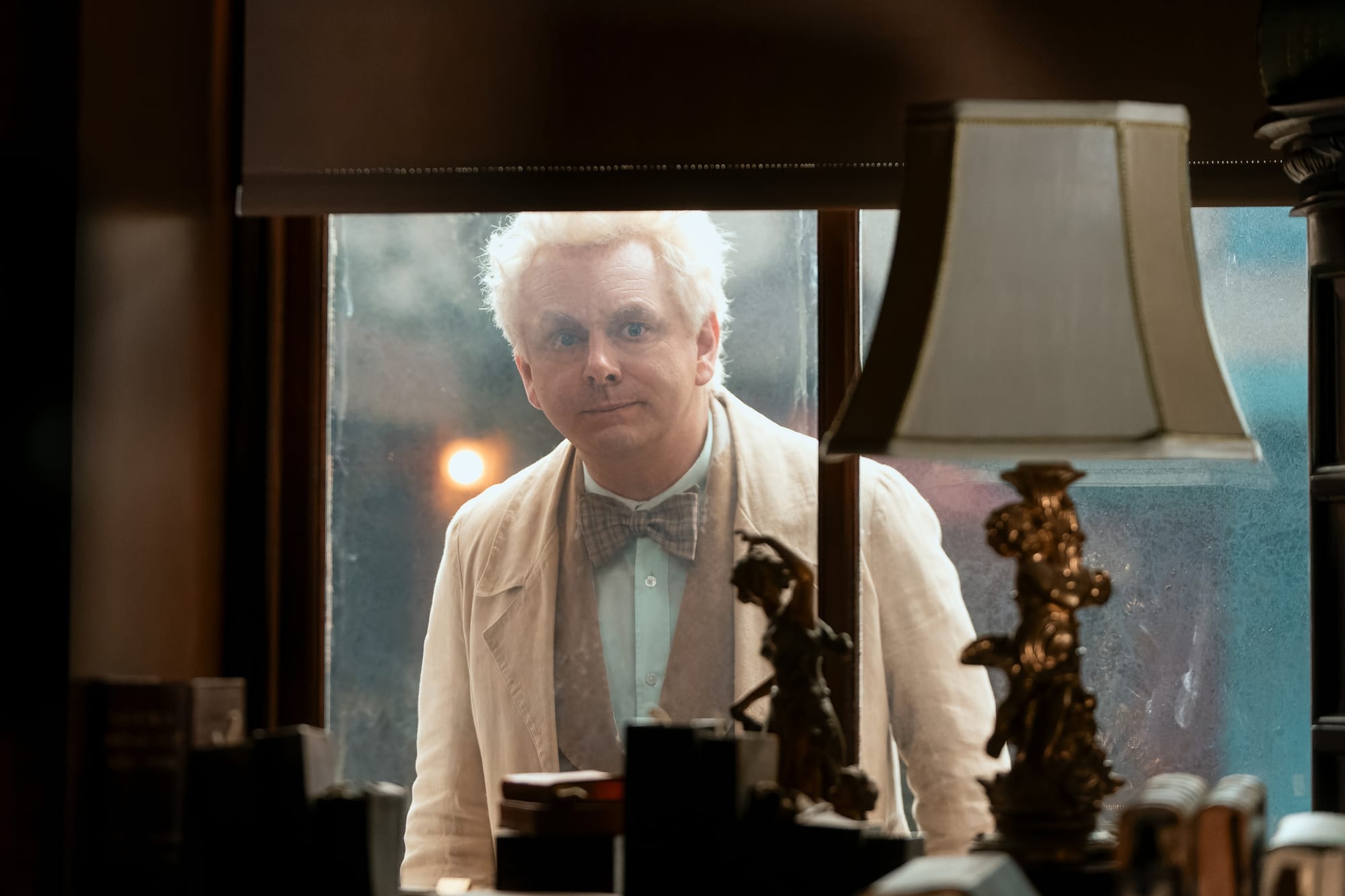
Good Omens has always been a story that values the spirit over the letter of the law, repeatedly choosing compassion and understanding over rigidity and literalism. Technically speaking, “The Finale” is not a particularly great episode of television, it’s true. But for all its flaws, it's also an ending that doubles down on some of the most powerful and deeply romantic ideas of the entire series. Namely, that love, in every form, is a radical act. It always has been.
To love something, in a sense, is to be transformed by it. It is a relinquishing of self that is meant to reforge us, to shape us into something new, into something more than we were before. Love is both a gift and an exhortation, the greatest vocation we have all been called upon to answer. (In the Gospel of St. John, it is Christ Himself who tells us that “I give you a new commandment: love one another.”) And, in the end, it is love that shapes every aspect of Good Omens larger story.
In the Garden of Eden, Crowley tempted Adam and Eve to disobey, so that they might have the power to choose their own futures. Aziraphale broke the rules to gift Eden’s fleeing humans his sword, and spent the next six millennia lying to the Almighty about what happened to it. These are, in their simplest forms, acts of love.

So is everything that comes afterward, from Aziraphale and Crowley slowly deepening into something more romantic friendship to their evident and boundless affection for all the everyday wonders humanity ultimately proves itself capable of. It’s all love, and the choosing of it over and over again.
Yes, “The Finale” ultimately resets the series’ universe to a more overtly humanist flavor, removing such things as angels, demons, and celestial infighting from its larger canvas and leaning into ideas of free will, agency, and self-determination. Both God and Satan appear to take their proverbial fingers off the scales and leave mankind to its own devices.
In this new reality, it is our own hearts that serve as our better angels, without threat or coercion, witness or reward. We are called, once again, to love one another, as Jesus himself once asked us to, only this time for no other reason than we should. Because we are beings that are made to love. Made in love. It is, after all, why we are here.
Good Omens, in many ways, is grounded in the idea that things like faith, hope, and love are not distant theological concepts, but active verbs. They are something that you must do, rather than something to be passively encountered. Aziraphale and Crowley choose humanity, in the end, because it is humanity that made their existence so worth all the trouble. It is humanity that ultimately taught them what it meant to love each other, and that love literally rewrites the universe.
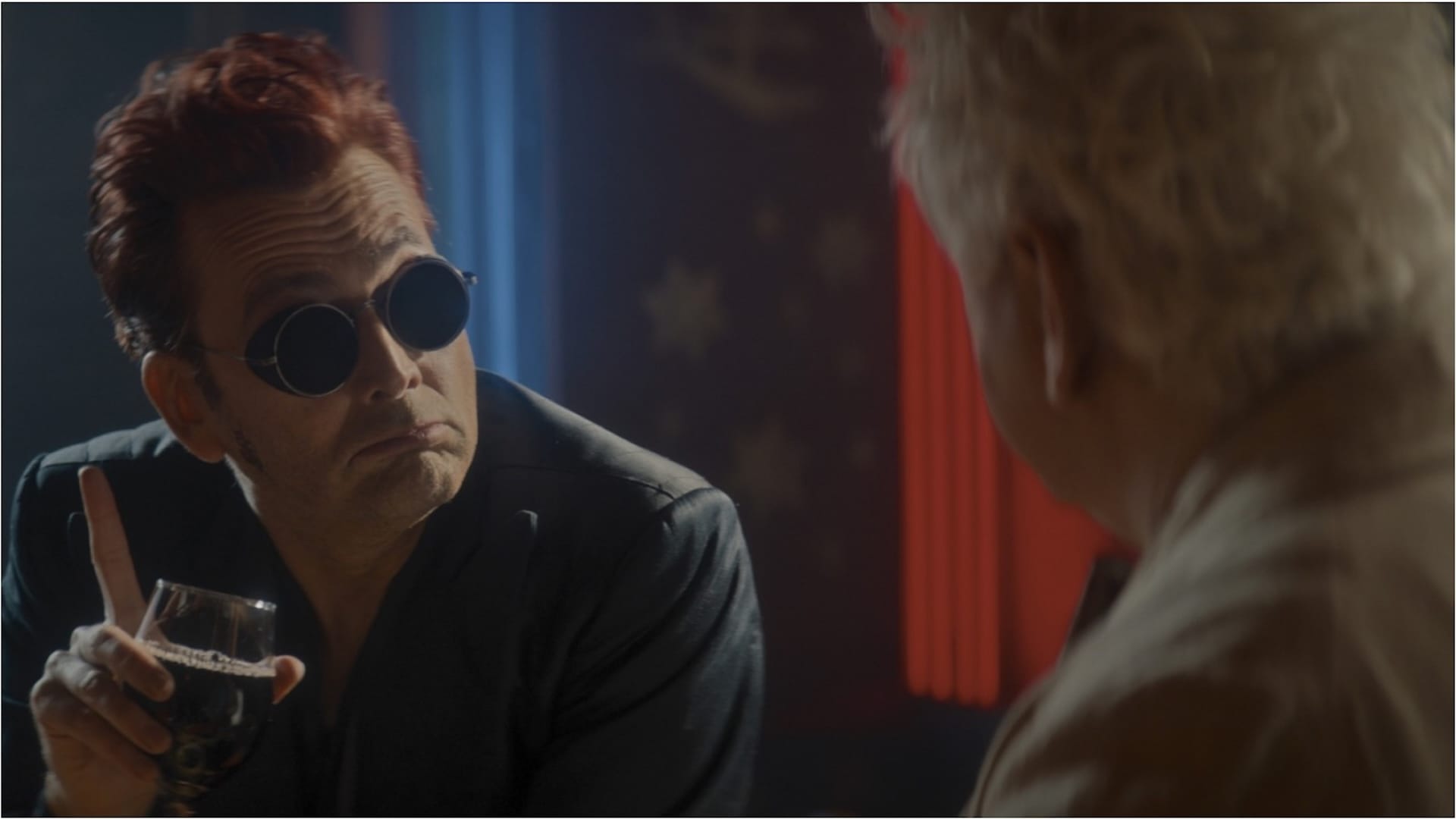
This is perhaps why I would still argue — even if I were not a person of faith — that the idea that this is somehow a Godless universe doesn’t completely work for me. A world without Godlike hierarchies is not the same thing as a world without God, and who’s to say the Ineffable Plan didn’t turn out exactly the way it was supposed to, in the end? Everyone does seem to find each other again, after all, if you take a look around that London pub in the finale’s closing moments. (Hebrews describes the concept of faith as the substance of things hoped for, and the evidence of things not seen. We still end up where we’re meant to, I’d say.)
“The Finale” ends with the birth of a new world. One where there are no sides, no factions, no millennia-long vendettas that seem impossible to unravel. There are no angels or demons, just two very familiar-looking humans who somehow find their way to each other in a world of a billion others, have dinner, and get a lifetime of quiet joy together in a garden. It is love, as an ineffable miracle. It is love, as an active choice. It is love, in the end, that lasts.

Comments ()