

'The Vampire Lestat' Believes in Soulmates

AMC’s The Vampire Lestat is, technically, a story about Lestat de Lioncourt (Sam Reid). It’s right there in the title, after all. And that story certainly takes many forms over the course of this seven-episode season, audaciously leaping between genres and styles as it chronicles everything from his difficult childhood to his over-the-top rockstar era. But while the series gleefully unpacks Lestat’s past and tugs on the lingering threads of trauma woven through his present, it’s doing all of this with a remarkably clear goal in mind. You see, underneath all the glam and the rage and the angst, The Vampire Lestat is still, at its heart, a love story.
Yes, it’s also an exceptionally bloody tale about a lifetime of trauma, frequent self-loathing, a crippling fear of failure, and a hefty dose of the bleak vampiric loneliness that’s the ticket price of immortality. But it’s also about two broken people finding their way back to each other not just because, as one puts it, no one else will have them—a surprisingly romantic statement in this context, believe it or not!—but because they’re simply better off together than they are apart.
The relationship between Lestat and Louis de Pointe du Lac (Jacob Anderson) sits at the center of the Vampire Chronicles, though their love story is textually relegated to the background for big chunks of Rice's sprawling series of novels. (Thematically, however? Their relationship, as well as its long-tail impact on the vampire Lestat both is and becomes omnipresent.) The AMC series has made things a bit more linear and literal, essentially building its entire narrative around the Loustat romance. They are our primary POV characters, and their connection is the linchpin around which much of the franchise turns. And while their relationship is not at the forefront of the bulk of the series’s third outing, it remains the emotional backbone upon which almost every aspect of its story hangs.
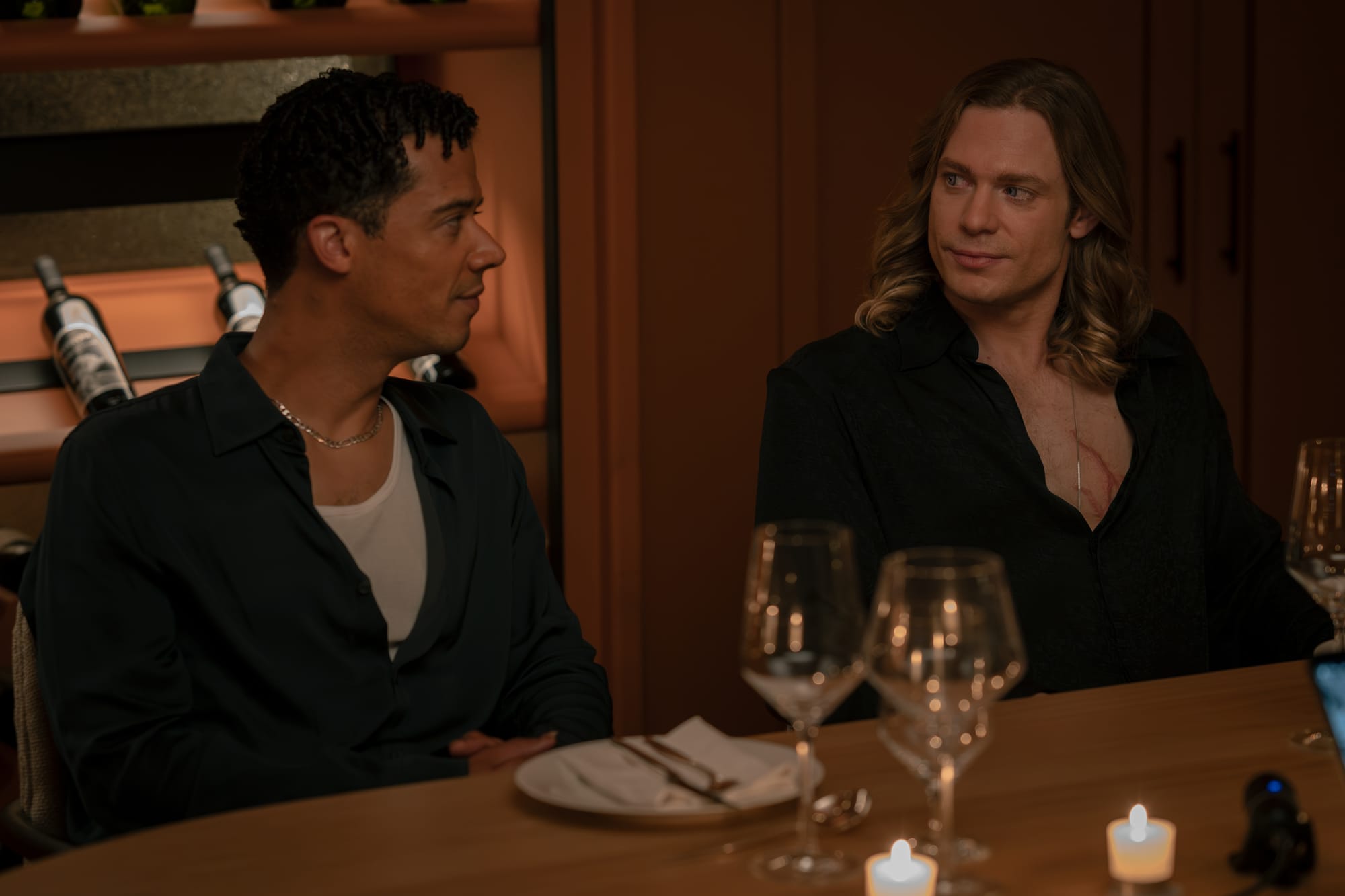
The first two seasons of the show — when it was called Interview with the Vampire – are our introduction to both Lestat and Louis, and the latter’s frequently unreliable narration serves as a gateway into Rice’s larger world. An exploration of how Louis views himself, those he loves, and what it means to live forever, it’s a slow-moving, thoughtful unpacking of his character, his relationship with Lestat, and how he wants to see himself in the world. Rebranded as The Vampire Lestat for its third installment, the show embraces a more gleefully chaotic tone and structure, but its overall themes are much the same, merely explored through the lens of a character who has simply been around for a whole lot longer and endured much (much) more.
The novel The Vampire Lestat is told largely through historical flashbacks. Readers are shown Lestat’s youth, his early days in Paris with first love Nicolas de Lenfent, his violent turning at the hands of his vampire Magnus, the founding of the Theatre des Vampires alongside Armand, and his introduction to Those Who Must Be Kept, all in roughly chronological order. These events all take place on the show, but are granted much less screen than page time and are presented much less linearly.
Instead, the show weaves memories of Lestat’s past into the story of his present, using the series’ songs (written by Daniel Hart) to thematically unpack the impact of all the grief and trauma that Rice’s novel depicts more directly. But, in doing so, the series not only repeatedly underlines the long-tail impact of these events on Lestat’s perception of himself and his past, but also how his feelings for Louis are, for better or worse, inextricably intertwined with who he is.

Subscribe to The Shipping Lane! Sign up and get our content sent right to your inbox --- it'll let us know you love us. 💘
The Vampire Lestat has been remarkably honest about Lestat and Louis's mutual failings. Yes, both are broken, traumatized creatures who have real darkness in them. They're genuinely fucked up, both separately and together. They've hurt people. They've hurt each other. Neither of them is perfect, and it's more than fair to question whether their frequently toxic relationship, with the many lies, self-deceptions, and outbreaks of violence at its center, is something we should be rooting for at all.
Yet, it’s almost impossible not to be moved by the depth and consistency of their longing for one another, and, perhaps most importantly, the peace they ultimately find in each other’s presence.

In Rice’s world, the idea of living forever is as much of a curse as it is a gift. The endless possibility of immortality walks hand in hand with the fear that we can never truly escape the mistakes we’ve made. That the pain we carry will always haunt us. But if The Vampire Lestat has a central theme, it’s that our failures — however plentiful or horrifying they might be — are not all that define us. And Lestat and Louis’s relationship is nothing if not proof of that.
In a season that forces both characters to confront some of the ugliest and most shameful parts of themselves, from Lestat’s incestuous relationship with his abusive mother to Louis’s disturbing obsession with a young woman who physically resembles the daughter he lost, there is also explicit affirmation of their unshakeable faith in — and connection to — one another.
It is Lestat that Louis calls when he loses his ability to discern reality, and who takes his feelings about “Fraudia’ seriously. It is Louis who stays through Lestat’s sex tape panic attack, who chooses to push through his own (admittedly, understandable) disgust to physically hold on to the person who needs him most. (Neither of them necessarily gets to these moments of catharsis easily, mind. But that they do, in the end, counts for a heck of a lot.)
With so much death, loss, and destruction between them — as well as a near century’s worth of time apart — many of the rough edges of their lives together have been sanded down to something softer and more flexible. The toxic power imbalance that colored so much of their early relationship in New Orleans is gone. Both now have their own separate professional interests, and each has had romantic (or at least sexual) relationships with others. They’ve tried, even mostly succeeded at, living without each other.

Yet, it’s equally evident that no matter what the specifics of their lives look like, they ultimately still revolve around one another. Louis made sure he got a cut of Lestat’s merchandise sales to keep him close and built a restaurant three blocks from his Montreal home. Despite his initial protests, most of Lestat’s songs turn out to be about Louis. (Much to Gabriella’s dismay). And it is through realizing their love for each other, despite all their respective mistakes, misunderstandings, and struggles to grasp the other’s perspective, that each finds peace, even in the face of seemingly certain death
Louis cannot–truthfully, will not—deny that Lestat is the love of his life, even as his own severed head drips gore onto a butcher’s table in front of his vengeful ex, Armand (Assad Zaman). It is the possibility of a future with Louis (“Could be nice. Could be.”) that grounds Lestat during his interrogation at the Long Table, and the specter of his brother that brings him comfort in what he believes to be his final moments. In the end, Lestat has loved — and been loved — all along. That is the very antithesis of failure. It is, perhaps, the only thing that really matters. That has ever mattered, as a pair of matching decapitation scars can now attest.
All three seasons of Interview with the Vampire/The Vampire Lestat are streaming on AMC+.

Comments ()